DEPARTMENT OF CHURCH HISTORY
„Lord, let me keep searching. My sweet Hope, do not let my attention be confused. There is a past and a future, but I want to know where they are. Though I may not yet be strong in this knowledge, yet I know that wherever they are, they are there not as past and future, but as present. For if the future is the future there, then it does not exist even there. And if there is a past there, there is no past there. Therefore, wherever they are hiding, whatever they are, they cannot be other than the present.”
(Saint Augustine)
The fact that Christ entered into human history two millennia ago is less and less disputed. Non-Christian historians such as Tacitus, Pliny, Svetonius, Josephus Flavius all mention this extraordinary event, which was barely comprehensible to outsiders. The church, which grew out of the community of Jesus and his disciples, and whose mission was to preserve and transmit the good news of Jesus Christ and the truth of the gospel, has had a long, winding, sin-laden and highly productive journey lasting more than two millennia. It is common knowledge that the faith of the Church has never been independent of historical events, discoveries and social changes, but has been shaped in their context. For this reason, it is impossible to interpret past events and assess future outcomes in a meaningful and effective way without a thorough understanding of human history. Therefore, it is essential to know the history of Christ’s Church and to discover its context, if we are to lay a foundation for profound theological considerations. Church history as a subject, following the classical division of world history, is presented in four parts over the course of four semesters, which are further developed in the context of seminars.
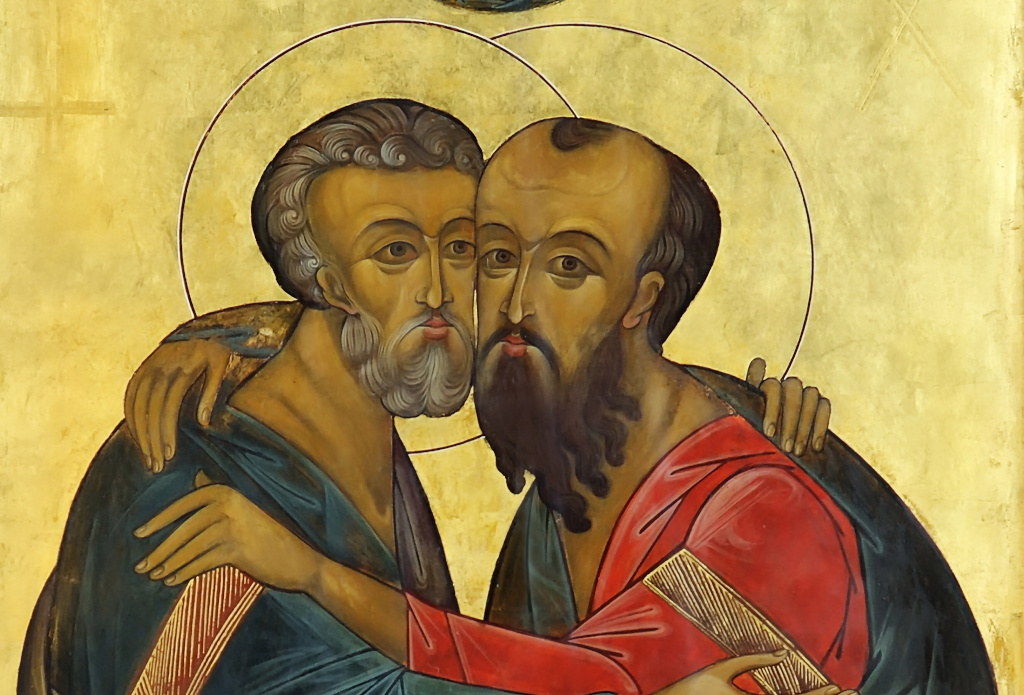
Szent Péter és Szent Pál apostolok – ikon
Compulsory and elective subjects offered by the department:
-
Church History – Antiquity
-
Church History – Middle Ages
-
Church History – Early Modern Era
-
Church History – Modernity
-
History of Chrisitan Denominations
-
Patrology
Although the idea that Jesus was a fictional – and not historical – person was reintroduced in the second half of the 19th century, Jesus’ historical existence is no longer disputed by anyone who considers himself a researcher and serious thinker. Those who do not consider the Scriptures to be adequate and objective proof of the existence of Jesus are advised to consult the writings of Tacitus, Pliny, Suetonius or Josephus Flavius, all of whom are non-Christian writers who make mention in their works of Jesus and his followes. The starting point, the nucleus, prototype of the Church is a community of Jewish men, that is, Jesus and his twelve Apostles. This community experiences steady growth following Jesus’ death on the cross and his resurrection. In time, the community came to welcome men and women from among the Gentiles, and thus developed into a completely heterogeneous group. The Christian community was given the task of making the teaching and example of Christ understandable to humanity in all the ages. The faith of the Church has evolved over many centuries to become the sum of what we believe today. It has been a long journey, abounding in sin but overflowing with grace. In order to gain a deeper understanding of a particular doctrine, we need to know the circumstances of its birth and development, the state of society at the time, the historic and cultural context in which it was born, and the journey it has undergone to acquire its present day form. Church history, as its name suggests, is primarily concerned with the history of the Church over two thousand years, never in isolation from universal human history but always deeply embedded in it.
A Tanszék oktatói

Dr. CSONTA ISTVÁN
tanszékvezető főiskolai docens
doktori fokozat PhD-STD,
Katholieke Universiteit Leuven (2020)
oktatott tárgya:
Egyháztörténelem 1: ókor-középkor; Egyháztörténelem 2: újkor-jelenkor; Felekezetek története;
II. vatikáni zsinat
e-mail: csonta.istvan@pphf.hu
fogadóóra: szerda, 11:00-12:00